
Problem Solving for a public-private sector skill development institution
A national skill development institution was looking to help ITI principals from across India strengthen their problem-solving capability for real institutional challenges.
ITI principals operate in an environment where every day brings a mix of administrative, academic, people and operational issues. Some problems are straightforward and can be solved with expertise, process and experience. Others are more complex, involving students, faculty, parents, industry partners, government systems, resources, culture and expectations. In such situations, leaders need more than quick answers. They need the ability to pause, examine assumptions, involve the right people and solve the right problem in the right way.
We designed a Problem Solving program to help ITI principals approach challenges with greater structure, curiosity and discipline. The session began by defining problem solving as the process of identifying a challenge or obstacle and finding a way to overcome it. Participants explored why effective problem solving requires critical thinking, creativity and flexibility, especially when circumstances are changing.
The topics covered included:
Definition and importance of problem solving
Key stages in the problem-solving process
Identifying the right problem to solve
Challenging assumptions
Gathering relevant data and inputs
Solving the right problem versus solving the problem right
Complicated versus complex problems
Perception, action and will in overcoming obstacles
System 1 and System 2 thinking
Mindfulness for better problem solving
Growth mindset in problem solving
Constructive conflict
Experimentation and iteration
Relentless preparation
Precision and attention to detail
Teamwork as a force multiplier
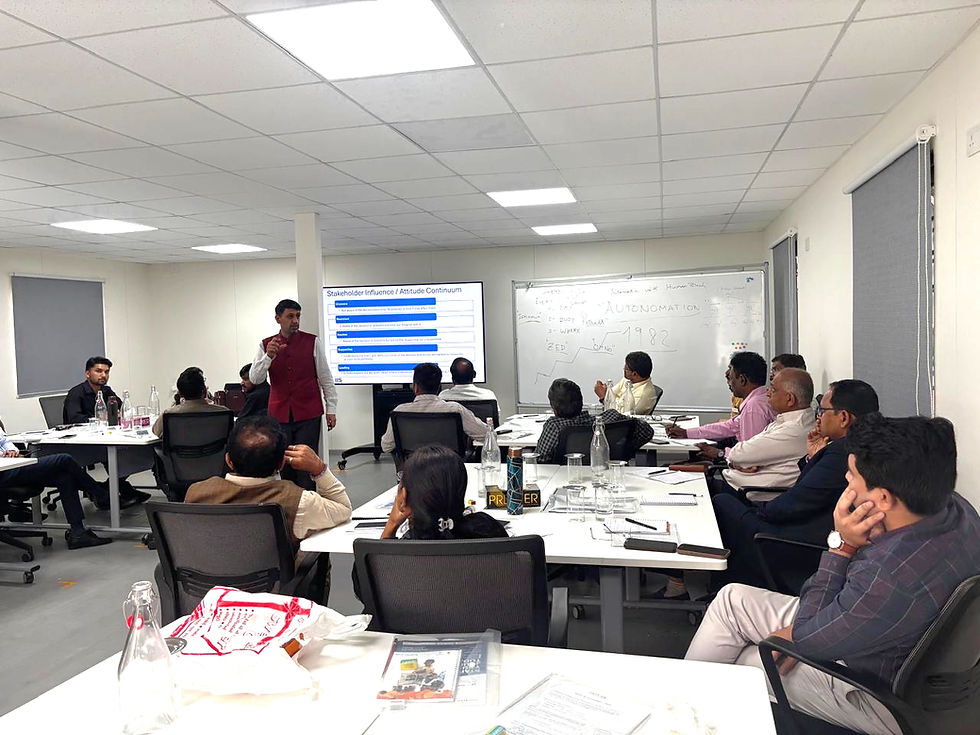
The session was highly interactive, with group activities, reflection exercises, case discussions and team problem-solving tasks. Activities such as forming a line, building a house of cards and a treasure hunt were used to help participants experience problem solving in action, observe team behaviour and reflect on how different approaches affect outcomes.
Through this intervention, ITI principals strengthened their ability to slow down before acting, challenge obvious answers, involve others constructively and approach institutional problems with more clarity and confidence.
If you are interested in helping your leaders solve complex institutional problems with more structure and confidence, reach out by booking a free discovery call with us.
At a glance
1
Session(s)
6 hours
Interactions
4.72
Feedback (on 5)
Education
Industry
In-person
Mode
Project Gallery


